 S3E2
S3E2
· 37:54
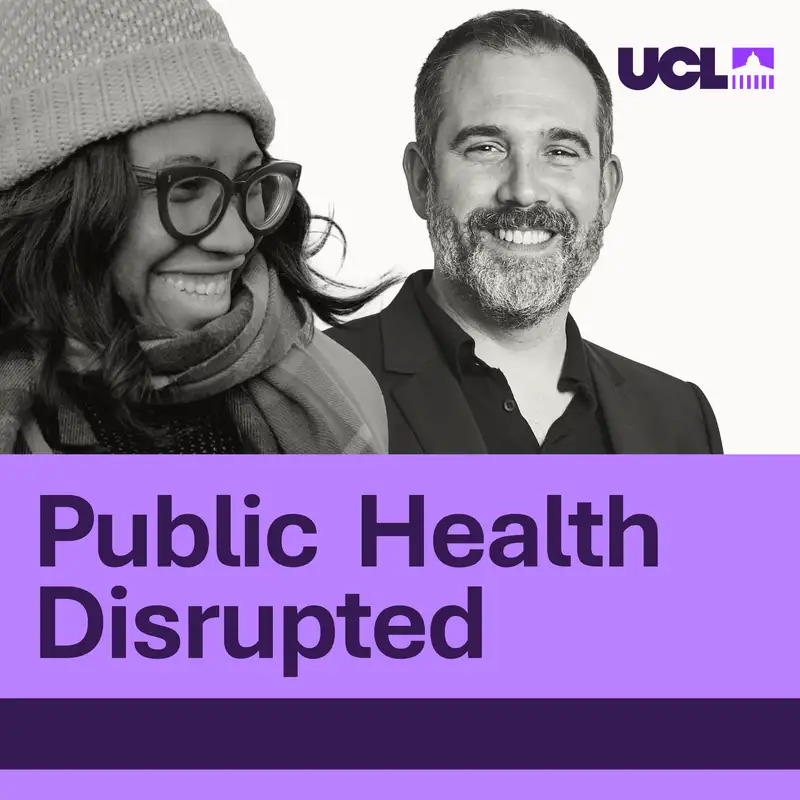
Hello, and welcome to season three of Public Health Disrupted with me, Xand van Tulleken.
Rochelle:And me, Rochelle Burgess. Xand is a doctor, writer and TV presenter, and I'm a community health psychologist and associate professor at the UCL Institute for Global Health.
Xand:This podcast is about public health. More importantly, it's about the systems that need disrupting to make public health better. So join us each month as we challenge the status quo of the public health field, asking what needs to change, why and how to get there.
Rochelle:In today's episode, we're tackling the world of food science. We're observing an age of eating, where thanks to our increasingly fast paced and complicated lives, convenience is king where food is concerned. A far cry from the foods available to us until relatively recently, many of us are now fueling our bodies with an entirely novel set of substances called ultra processed food. In today's episode, we're taking a closer look at this industrially processed food, which is designed and marketed to be addictive and asking the question, do we really know what it's doing to our bodies and to our societies?
Xand:Helping us to dissect all this today are Chris van Tulleken, my identical twin brother, and Christina Adane. What are ultra processed foods? What do they do to our bodies? How effective can exercise really be in reversing the effects? Well, Chris and Christina will be shedding some light on how ultra processed food is affecting our health, our weight and the planet.
Rochelle:Christina Adane is a social campaigner who led the Bite Back campaign to extend free school meals into the holidays during the COVID nineteen lockdown in 2020. Passionate about tackling food injustice and the climate crisis, her work has been recognised by the Duke and Duchess of Sussex, who welcomed Christina as a guest on their podcast, and by the BBC, who named her in their most inspiring 100 women of 2020. In 2021, she won the Diana Legacy Award for her efforts with Bite Back in fighting for a fairer food system.
Xand:We're also joined by my identical twin brother, Chris Van Tulleken. Now Chris diseases doctor at UCLH, and he's one of the BBC's leading science presenters having worked on many Tulleken. Flagship health and science programs. His research at UCL focuses on how corporations affect human health, especially in the context of child nutrition. He works with UNICEF and the WHO on this area.
Xand:Chris also co presents CBBC's Operation Ouch alongside me, and that series involves lots of self experimentation and lab work to find weird and wonderful ways of showing kids what goes on in hospitals and inside our bodies. Chris has recently released his book Ultra-Processed People that explores the world of ultra processed food and the effect it's having on the health of the public. So, Chris, you've just finished this book, and I know how much effort you put into writing it. I wanted to start with you because you've been so helpful for me about just explaining what ultra processed food is and the impact it has on our health. Your book really changed my life and my way of eating.
Xand:So can you talk about what it is, how it affects our health?
Chris:So ultra processed food has a
Xand:long
Chris:formal scientific definition that boils down to this. If it's wrapped in plastic and it has a funky ingredient that you don't typically find in a domestic kitchen, then it is likely to be ultra processed. And the definition was invented by a team in Brazil in 2010, and it's been tested like all good hypotheses. It's been tested robustly since then, and it's very much stood up to testing. And the hypothesis was simply our industrially processed packaged foods, I.
Chris:E, what most of us now eat in The UK, responsible for diet related disease, more than the individual nutrients they contain. So one of the the sort of glitches in the nutrition matrix of data over the last fifty years has been that we've had this shifting anxiety around, is it fat? Is it sugar? Is it protein? What is driving this pandemic of particularly obesity, but also now diet related disease, so cardiovascular disease, inflammatory bowel disease, metabolic disease like type two diabetes?
Chris:These are now the leading causes of early death on planet Earth. So it's not simply a lay description of a of a bunch of different items that you might intuitively arrive at. It's a formal scientific description that has allowed a lot of testing.
Rochelle:You know, I have a question about that, Chris, and it sort of comes from the few spaces in my life. So one bit around motherhood where stuff in wrappers brings such ease to an insanely hectic, hectic life, but then also my interest in inequalities and who gets access to certain kinds of foods and healthy foods around the world. And so I guess my follow-up question to that is, can you tell us a bit more about these relationships? So who is most impacted by this and how that fits with inequalities also?
Chris:So it's such an important question. A lot of what I write and say about this is had as an argument with many different people, primarily industry. And one of the very sophisticated critiques of the ultra processed food academic literature that is mounted by industry is that it is fundamentally anti feminist, because convenience foods have allowed women to enter the workplace. And with the rise of things like TV dinners and pre prepared food, we've had a big shift in the labour market. The other argument that's mounted is that critiques of ultra processed food and this is something I think I really I interviewed Christina for my book, and I've known Christina for a long time, but this is something I spoke to her a lot about is the critiques of ultra processed food are fundamentally racist because ultra processed food is is predominantly eaten by people who are already disadvantaged.
Chris:So there are there are two ways of of thinking about this. I mean, my approach is to say, first of all, everyone has a right to information that is truthful and unbiased. And the information, the scientific evidence around the health harms of ultra processed food is now very robust. And so critiquing it is actually the first step to reducing the disadvantages and the inequalities that are brought about by the food system. Now the critique has to be really sophisticated because if we say, well, look, this stuff is unhealthy, so we're gonna treat it like cigarettes and tax it, or we're gonna put it all in plain packages, you're gonna end up, first of all, stigmatising the people for whom this is essential food.
Chris:So so there's a big thing in the moment in The UK. There are a number of sort of health commentators who who run personalised nutrition websites, who broadcast on social media, and everyone's very taken up with the idea of ultra processed food, and and the middle classes are now quitting this. But for many people, this is the only affordable available food. It's the only food they have time to prepare. It's the only food their children are used to eating.
Chris:And so what to do with the information, I think, is the, you know, is is the subject that that podcasts like this can really deal with effectively in a nuanced way. But there aren't easy answers in it. You know, we got we have to acknowledge that.
Rochelle:Yeah. I think that goes really nicely for us to talk to Christina about your work, because it feels like this is very much a space for multilevel activism. And so, Christina, I wonder if you could tell us your thoughts about how this this fits into what you do and your take on ultra processed foods.
Christina:Well, young people in The UK are growing up in a broken food system. We're growing up in a food environment that means that one in three young people by the age of 11 years old are at risk of diet related ill health. So when we're talking about this we really need to look at it from a systemic point of view, and look at the physical and online environments in which young people are growing up. When I was in school, I lived in South London, so I, in a food desert, which is an area or high street with little to no access to nutritious affordable food, but loads of junk food. So I just walked in my local area, I know it obviously like the back of my hand, and it's tons of chicken shops, Chinese takeaways, just adverts for 99p burgers, and then my school was in Westminster, so I'd cross Vauxhall Bridge and go into my school area and then suddenly it's Pret's and Leon's and it's nutritious food, or at least nutritious food that's marketed, at a price that's just out of my range.
Christina:And then I go online, I go on social media, I have my favorite influencers, celebrities, like doing loads of product placement ads for these big food companies. I get told that this is what I want to eat, so we've already got the affordability point of what's affordable is junk food. What's sexy, what's being made to be the cool thing is junk food. And it's everywhere, it's literally everywhere in so many different forms. So I feel like when we're talking about children's nutrition, we need to realize that this is something that needs, that action needs to be taken from the top down.
Christina:We can't expect parents to fight against this flood of unhealthy food that their them and their children are facing by themselves.
Chris:I mean, to me, that's such an important point that people always ask me, you know, do you have you banned this for you know, knowing all the science, have you banned this with your kids? So I have a a five year old and a two year old. And absolutely, I have not banned this because it would make them very weird. It would make them unpopular. It would make it impossible for them to go to parties and eat normally.
Christina:Mhmm. Mhmm.
Chris:So it's it's, you you know, stigma. If we don't if we don't stay alive to the stigma of what we say about this, it's it's really important. But Christina was so important for me understanding the difference between her life as a, you know or I should say this to Christina. I mean, Christina, you were really important for me understanding the difference between your life as someone in your teens, you know, going to the school you went to and how saturated you are in the marketing. It's on your bus tickets.
Chris:It's in your apps. It's everywhere. Whereas if you're if you're a public health academic like me or you're a doctor and you're a telepresenter, I pay for my Spotify. I pay for my YouTube. I pay for my subscription channels with no ads.
Chris:I don't get the bus. So I'm I'm literally not this stuff is not marketed to me. I'm I'm unavailable. And so it's it's people who have to where where ads are paying for services, people become extremely vulnerable.
Christina:And and even then, Chris, I've been in rooms where, like, been amongst the most educated, the most senior people in big food and in government, and they still find it hard to eat healthily. People still struggle with their weight and their diet despite, you know, having access to some money and to to healthy food because because of how, like, mammoth this industry is. Everyone is a victim of this system, but we we all should feel empowered to hold hold these systems accountable as well.
Chris:I I personally love that point. Because until you point out to the members of parliament and the policymakers that Christina and I speak to, until you point out to them that the sandwich they're eating for lunch that is organic, vegan, and the you know, that they've had these nuts rather than, you know, cheese, onion crisps, they're drinking, you know, one of those new bacterial drinks. Until he point out to them that that is all ultra processed too, they don't really connect with it. But yes, the the problem is now so universal that it is essentially impossible to eat lunch on the high street from a from a normal lunch place. You know, it is all roughly equivalent.
Chris:And I think that's such a powerful point.
Xand:Christina, can we just I I do wanna hear more more from Chris about the specific ingredients. But Do you, though? Well, maybe I do I actually wanna hear more about it? I mean, this is all I ever hear about at home, in the car, on the train. This is all he ever talks about.
Xand:No. I mean, literally. I mean, look. I I I should say right off the bat, like, every single thing I buy, I look at the ingredients list. And if it has an ingredient that I don't have in my kitchen, I do not buy it and I don't eat it.
Xand:And it means that I am you know, Christina, your line about going, it should be easy to eat healthily for everybody. You know, I am a health care professional with an interest in health. I'm getting married to someone who's got PhD in the epidemiology of obesity and and the policy around obesity, and and I still find it enormously difficult. We stand in petrol stations and rage about it. So, Christina, you talk about change, and you are really an activist, or at least that's been a huge, huge part of your work.
Xand:Can you talk about the change that we need to see? Because I I think Chris has correctly anticipated that he has to be very careful not to be seen as a sexist, racist, privileged, white male academic judging everybody on on low incomes about what they eat. And and I know that he's very careful not to do that in in his heart and in his book. But what is the systemic change that you're looking for, and who should we listen to when we're going about seeking it?
Christina:I think who should we listen to is interesting and a difficult a more difficult question to answer. In terms of the change that we need to see, we need to completely redesign our food system, because I campaign specifically on consumer facing issues and issues that affect young people, but when you go all the way back to, like, how the food is produced, it's broken, and the impact it has not only on our health but on the planet as well. We need to see it completely redesigned. The level of change that I want to see is almost kind of yeah, it's radical. I don't know why I'm scared to say it, but it's radical.
Christina:And so I think where to start? We can start in schools, we can start in the way that young people are first engaging with food. The importance of getting young people into the habit of eating healthily, I think we kind of miss with our current state of school meals. If we did that, if we just provided free nutritious food for children, where we're kind of already training their palates to want good things and healthy food, our high streets, like there are no safe places for young people to hang out where, you know, we're not kind of bombarded with junk food. Right now the equivalent to that is a chicken shop or, you know, a McDonald's.
Christina:So actually why not create youth hubs where there's nutritious food available but young people can also just hang out and stay off the streets and not be subject to knife crime and all that kind of stuff. So the fact that there are no youth hubs and that young people just don't have anywhere safe to go is, I think, another reason as to why we're falling victim to the food system and something that needs to change. And our screens, junk food marketing is absolutely insane. There's a reason why these companies pour billions and billions of pounds every single year into marketing junk food to us, because it works and it currently has, like, my whole generation in a chokehold and it makes me look, like, uncool for talking about it, because, you know, I'm a young black woman that seems to be going against her culture because I'm, you know, in youth culture and black culture, fried chicken, as an example, has been something that has been marketed to us as ours, right? Like this is something that's sacred to us, this is what we have, this is our and you've got chicken shop dates of like this, you know, young white woman taking out wrappers for dates in chicken shops and that being the So cool there needs to be a complete cultural shift as well, like the change we're talking about is massive but I think it all starts from young people and just individuals realising that it's not our fault, it's really not our fault that we struggle with our health.
Christina:We have to look to the system around us for change and hold them accountable.
Chris:I think, you know, when Christina was telling me about chicken chops, for me, the evidence and the definition of ultra processed food allows us to sidestep that whole ugly issue, or at least manage it very effectively. Because fried chicken, in terms of it being a traditional cultural food, is a perfectly healthy food. It's when that chicken is essentially you have fake fried chicken. So you have fried chicken that's fried in oil containing dimethylpolysiloxane. It's fried in oil that's been hydrogenated.
Chris:The chicken crust contains ingredients like maltodextrin and flavor enhancers and ribonucleotides and modified maize starches. It's not really traditional fried chicken anymore. What it is, it's a it's a financial asset used to extract money from vulnerable people. The companies that own the chicken shops or any of the fast food chains are broadly speaking owned by wealthy majority white people in the high income parts of the world. And particularly now this is this is a problem in low income communities and minority ethnic communities in this country.
Chris:It's a huge problem in the global South. If you go to across Sub Saharan Africa, there are franchises, all the franchises we know from The UK. So Yum Foods that owns KFC is franchising across places like Ghana. And so this isn't really making traditional fried chicken. This isn't part of traditional culture.
Chris:This is fake culture and it's fake fried chicken. And I think once you The UPF definition simply allows you to ask the question, is this our traditional food or is this actually cultural appropriation? Someone, you know, a company, mean, Christine has talked very powerfully about this and I've spoken to other lots of other activists and chefs about this. This isn't the this isn't traditional food. It's essentially stealing recipes and culture.
Rochelle:That's a really powerful way to put it, I think, to sort of to say, actually, this is yet another way in which systems and companies take from black communities. I think that's probably the most powerful way I've ever heard it. You know, I grew up eating my mom's fried chicken, it doesn't taste anything like KFC or whatever. Am I allowed to say KFC? Edit that out.
Rochelle:I don't want them to sue me.
Xand:I
Chris:think you're allowed to say it doesn't taste like KFC. You're allowed an opinion on that. That's fair opinion.
Xand:Yeah. It's interesting how far it gets into your brain. You're allowed to if KFC sue k the headline KFC sues sues woman for saying her mom's fried chicken was better than KFC. You didn't even say it was better. You just said it was different.
Xand:Colonel Sanders is gonna be like, yeah. We use we use, only 11 herbs and spices. Maybe your mother needs to use another couple. But
Chris:it's the conflation. This conflation is so important for the for the transnational food corporations. And it's conflating, you know, it's going well. We make lasagna and and your mom makes lasagna. They've both got more or less the same ingredients.
Chris:They're both lasagna. What's the difference? You know? And it's it's all critique of any food becomes very confused. But ultra processing allows you to go, no, no, no, no, There's lasagna, and there's this other thing that isn't really food.
Chris:It's a food product. It's an edible formulation. It's an ultra processed entity, but it's not food and it's got nothing. It's got very little to do with lasagna. And the whole science of ultra processing from the mid nineteenth century has been to take traditional food, starting basically with butter, and make fake cheap versions of it.
Christina:That's it, isn't it? I sort
Rochelle:of feel like, yeah, it's capitalism.
Xand:It is. I mean, Chris writing his book, Chris would just go he'd phone me and go, like, it's capitalism. It's just capitalism. You know, you can't you can't critique the food system without without getting that far. We can't just roll our eyeballs and go, it's capitalism, baby, and move on from that thought.
Chris:We don't have to be cultural Marxists. You know, I don't have a political ideology that I'm going to bring to bear on this. But when we say it's capitalism, there are financial structures that motivate this system that provides our food. Unless we understand them and dissect them and understand the power forces and the power dynamics there, we will not solve the problem. And the important thing to understand is that if you beg and scream at the food companies, and Christina has very deep experience of this, you can go and plead with any of the, you know, 10 to 12 major transnational food corporations, and they will promise the earth and they will mean it, But they are unable to stop making food that is addictive and made from the worst cheapest possible ingredients because they are owned fundamentally by people like me.
Chris:So my pension, whether it's the NHS pension or a private pension, is invested in Yum Foods, in Nestle, in the ABCD food producers, in it won't be in two of them because they're private companies, but it'll be in Unilever, it'll be in all the people, it'll be in McDonald's a 100%. And so until we kind of understand that the companies the basic conclusion is governments have to regulate the food industry. And that requires grassroots activism because the government needs a mandate, and it requires doctors and scientists not to get in bed with the industry that's harming people. Because at the moment, we have doctors with a very close, cozy relationship, government with a very cozy relationship, and there is no appetite to stand up to the transnational food corporations.
Rochelle:Yeah. It's gotta be bottom up. I feel like bottom up activism, bottom up social change, you're right. Unless that happens in a way that is demanding divestment and those types of practices, you're locked in a cycle. And very few people realise how deep that cycle goes, I think.
Rochelle:Mean
Chris:So there's an entire theory of how the food companies work, which is that they are banks primarily. So most of their income, particularly the food producers, which is the ones, the really big ones that you've probably never heard of. So Louis Dreyfus, Archer Daniel Midlands, Cargill, Bunge, these these people who take crops, grains, meat, and turn them into some kind of food ingredient, they're mainly banks. So most of their money is made from commodity trading. Have some grain, but they trade the future contract on that grain.
Chris:And so the other thing about divestment, I think the evidence is very strong that divestment will not work as a strategy on its own. Because if University College London takes its pension and its investments out of, let's say, those ABCD companies, it does not affect the share price because there are so many willing buyers. And even if it does moderately affect the share price, the dividend gets bigger. So it has to be clamped down rules, you know, trans border regulation going, you know, we're going to demand different things. But the main thing is people have to the capacity and finances to shop differently.
Chris:Because as long as we're involved in buying soy protein isolate in our chew bars, the only way of producing those chew bars is to cut down forest in the Mato Grosso and ship that soy around the world.
Rochelle:Okay. So I have a question as a mom now, you know, I've sort of been writing notes saying, Make Theo eat his vegetables. And I think that that's what that's ultimately saying is like, how do I, as a parent, try to sort of navigate this system as sort of as an individual making choices to enable him to eat more healthily? How do I navigate that as a parent? That would be my question for you, Chris.
Rochelle:And then the flip side question for you, Christina, and I would love to hear you answer this first, actually, how do you as a young person or when you were a child, how did you actually find yourself navigating through that web? Like, are you able to make those kinds of choices? What do you need? What would you have needed as a young person to enable you to make better choices about what you eat and what's I in your
Christina:think, firstly, to your anecdote, I think the most powerful thing you could do as a parent, I know this wasn't my question, but
Rochelle:It's okay.
Christina:It's to
Chris:I want you to answer my question, Christina. I should say is Christina went to the same school as my wife. She's a young person that I intensely admire. And so I bring a lot of this parenting stuff to Christina, because I think, you're a, you know, you're a girl growing up in London, you may get to the same school as my girls. Like, how do I do all this?
Chris:Christina has much more expertise than me.
Rochelle:Alright. Go go, Christina. Answer both. Save me.
Christina:I think it's I think it's to point to the system around you. Think, sure, telling your kid to eat your vegetables, I mean, the best thing it's gonna do is gonna build resentment in your kids because they're gonna be like 'I don't want to eat these vegetables' but actually what really works for young people is when you appeal to their anger. I think I've had this conversation with Xand before. Point out the fact that they're being manipulated by this big food industry, and as a parent yourself, be an advocate. I think that makes you a much cooler parent because they're like, oh my gosh, yeah, like, you know you're learning together, but also it gives them a reason as to why they should eat their vegetables, they should be defiant, why they should break the cultural norms.
Christina:But as a young person it is really hard to navigate the food system because I started campaigning for this when I was 15, out of anger and realization that I was, you know, twice as likely to develop obesity, that I was likely to die around ten years earlier than my wealthier counterparts just because of where I grew up. I'm now, like, almost turning 20 and that system hasn't changed. And it's very personal to me. I think Dolly and Xand were there in parliament when I first broke down over this, because I was just so burnt out, was so tired of I had just come off a year of, like, talking to companies, trying to get them to change, and I was so jaded, and I kind of just, yeah, was fed up with the system. I told people for the first time that, you know, my sister is 11 years old, is overweight and blames herself for her health.
Christina:My dad has diabetes, my uncle has diabetes, you know, like this is stuff that like, yeah, it affects children, but like I've grown up with direct related ill health all around me, know, sixty percent of adults have to face this and now like a third of children do too. Childhood obesity didn't exist thirty years ago, like it's insane. So I think people need to realize how personal this is. Like look around you, you definitely know someone close to you that has has to struggle with their health. Why is that the case?
Christina:Like it's just not fair, it's not right. And it's just I went out to Thailand recently and I was seeing how, you know, these big food companies are creeping up into, you know, into emerging economies now and it's just the level of kind of anger that that creates in me and that should create in other people, I think we should use to really call out the system and hold these companies and ultimately government accountable. Because I completely agree with Chris, like voluntary corporate, like, engagement, it's not gonna create the change that we need. We need regulation. We need government to take care of its citizens.
Chris:Can I just say my reflection on what Christina was saying? I was just listening to her as if she was on a podcast. I was really enjoying it, and feeling quite stressed by it simultaneously, that my enthusiasm for this concept of ultra processed
Xand:food- She is on a podcast.
Chris:Exactly, but I was enjoying it. But my enthusiasm for ultra processed food, for the concept of it, is because it allows you to locate the problem in the food, the companies that make it, and the government that fails to regulate it. And this idea of it people are not to blame for the food they eat. We have to eat the food we can afford, that we have time to prepare and skill to prepare and that's available to us. And, you know, the definition UPF is the only way of considering how we begin to start interacting with, you know, the encroachment of transnational food corporations into Southeast Asia and East Asia.
Chris:This has snuck up on us. Gradually, over fifty years, more than half of us live with overweight and obesity. In in Central And South America, it happened over a decade. So everyone suddenly went, Oh, wow. I know people whose limbs are being cut off due to metabolic disease, you know, amputations because of diabetes, type two diabetes.
Chris:And so we lack in this country, we're essentially being gaslit that the problem is with us. It's about personal responsibility. We all need to eat less, do more. It is it is a a fabrication. It is it it is a lie.
Chris:And the the only thing that any of us can do is is vote and campaign and be activists. Sorry. That's my rant. I was just felt inspired by Christina.
Xand:Christina is a very inspiring person. It was very good when you got angry in in parliament that day. It was very it's very nice. There is a role for anger and activism, which you you talked about very well. Speaking of which, I think this podcast comes slightly out of a frustration with the field of public health, which is often very siloed, very focused on health, when in fact, in The UK at the moment, most people don't have the things they need to live healthily, and the public health academics are not gonna get them for them.
Xand:They're things like housing and money and available good quality food at a a price they can afford. So there is a need to disrupt the discipline and the way that we even conceive of questions in in public health. So we're asking every guest what piece of art or music or poetry, what object, what experience in your life, but something disrupted your your point of view to the point where you're sitting here with us now talking about how you both wanna change the world in very different ways. But, Christina, can I start with you? Was there a moment, was there a thing that shook your thinking up?
Christina:There's that's been a really recent one, actually. I watched a talk called Life on Mars by Eugene, Angelo and Reggie james and they're both very very cool young people in tech. I don't understand half of what they do but their talk was about the image theory and how images are essentially like a means to an end, like a belief system that reflects an unattained goal and how images are basically like you know the image of apple and how like that was the lifestyle in the 80s that everyone wanted to achieve. Now that we've achieved that lifestyle, you know, the image of apple is slowly dying and we're, you know, we're looking elsewhere for something new. Anyway, think that that really kind of is making me think about how I'm campaigning and what images we should be portraying, what belief systems we want people to kind of be following and what is that kind of goal?
Christina:Because we essentially need to replace what is cool and sexy at the moment, which is junk food, and how do we do that? So what is the image there? It's it's been what's been disrupting my thinking.
Chris:I mean, I think you are part of that, Christina, like it or not, you are one of the cool people. I don't think I should describe you as sexy, but you are part of the sexy cool movement that is making a resistance to the food system cool and sexy. I think you're now part of that.
Christina:I hope so.
Xand:Revolutions are sexy.
Rochelle:Revolutions should be seen like that. Like the revolution is cool. It was, I think people need to feel that, totally feel that because if you look at people who are involved in revolutions, they are always good looking people. I'll just say that, The head of movements, they're always great people. They're cool, they're funny.
Rochelle:I just think about movements in the sixties and all that. They were like cool, fun, hip, funky, and they still are. And they do hip, cool, funky, fun things. And everybody joined the revolution because that's where all the cool people are, in my opinion.
Chris:Think that's If you're gonna bring about change, you have to make a club that everyone wants to be a member of. And you know, I think Christina's much more capable of doing that than than me. But I can give the club some some advice some advice on how to administrate itself. Chris, you're you're cool and sexy too. Yeah.
Chris:Yeah.
Xand:How dare you say that my identical twin brother isn't cool and sexy. Chris, I'm quite interested in your answer to this because I actually don't know what you're you're gonna say. What piece of art, music, or poetry disrupted your perspective on life?
Chris:Can I be disruptive about this and just say it was just a line that someone said in a meeting the other day? It was a very dry meeting about limiting the influence of the infant formula industry over associations of healthcare professionals. And the meeting had been going on a long time. And we've been talking about how when industry funds research, whether it's the formula industry or the pharma industry or the food industry, how that creates bias in the research. And a colleague and really a friend called Melissa Mialon, who's a French academic who works in Ireland a lot of the time, said we must stop talking about bias, we must call it corruption.
Chris:And that was such a powerful idea to me about how we have sanitized as as a community of perhaps somewhat leftist, but but academic activists. We've become rather cowed in the language we use, but it is obviously corrupt. You can't if you're funding science and you're in any way manipulating that to get the answer you want, it's corruption. It's illegal. And yet we found this sort of rather gentle form of language, we've been coerced into it.
Chris:Melissa is one of those people who rather like Christina, like lots of the inspiring, slightly younger people that I work with, slightly younger, very much younger people I work with, at sort of, you know, reinvigorating that anger and thinking very carefully about the language we use and how to have the argument. And I just spend a lot of time now thinking about how how to best have this argument, whether to have certain arguments at all. There's almost no point in arguing with the food industry. But if you're going to argue with them, it's good to call them out on the really bad stuff. So when we talk about bias in research, we should talk about corruption.
Chris:Did I answer the question wrong? Did you want a poem?
Xand:Yeah. Pretty much. Not we just wanted to hear, like, that you like Picasso's Guernica or whatever, but that's fine. No. That's really good.
Xand:That's really good. Thank you. You both did a brilliant job. We massively appreciate you coming on and doing this. Well, if you're interested in learning more about ultra processed food, Chris' book, Ultra Processed People, is out now available everywhere.
Xand:I've got to say I've read it several times, and it changed my life.
Rochelle:You've been listening to Public Health Disrupted. This episode was presented by me, Rochelle Burgess and Xand van Tulleken, produced by UCL Health Public and edited by Annabel Buckland at Decibel Creative. Our thanks again to today's guests, Chris van Tulleken and Christina Adane.
Xand:And if you'd like to hear more of these fascinating discussions from UCL Health of the Public, make sure you're subscribed to this podcast so you don't miss future episodes. Come and discover more online and keep up with the school's latest news, events, and research. Just Google UCL Health of the Public. This podcast is brought to you by UCL Minds, bringing together UCL knowledge, insights, and expertise through events, digital content, and activities that are open to everyone.
Listen to Public Health Disrupted using one of many popular podcasting apps or directories.