 S1E3
S1E3
· 33:03
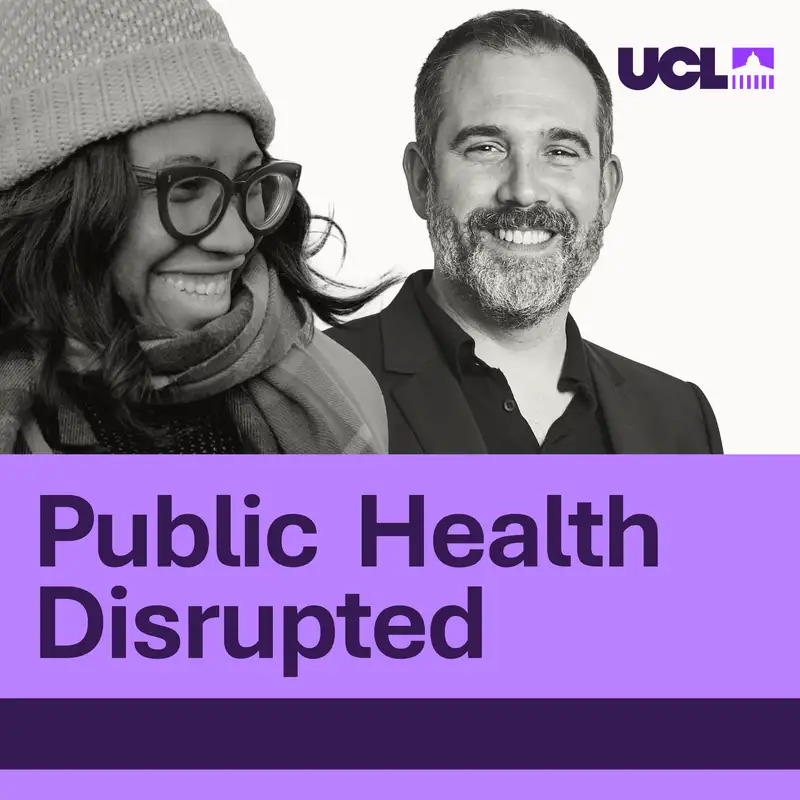
Hello, and welcome to Episode Three of Public Health Disrupted, the brand new podcast from UCL Health of the Public. I'm Xand van Tulleken. I'm a doctor, I'm a writer, I'm a TV presenter, and I'm prepared to do pretty much anything to start a conversation on public health. And I do mean anything, whether it's editing journals on humanitarian healthcare or experimenting on My Body for Children's Television.
Rochelle:And I'm Rochelle Burgess, a community health psychologist specializing in community based approaches to health around the world. I'm a lecturer at UCL's Institute for Global Health, a self confessed hippie, and as such here to talk about the importance of community, solidarity and social change to pretty much anyone and everyone who will listen. And this podcast is about public health, but more importantly, it's about the systems we need to disrupt to make public health better. So join us monthly as we challenge the status quo and ask what needs to change and why. Each week, we'll be joined by activists, scholars, artists, comedians, industry professionals, anyone we can think of really.
Rochelle:We want as many people from inside UCL and out to join in our conversation about public health.
Xand:Exactly. And we're calling this podcast Public Health Disrupted because that's exactly what we want to do. We're going to be breaking down disciplinary, sectoral and geographic boundaries. We want to really understand the diverse and complex issues impacting our health. So in today's episode, we're going to be exploring the role of discrimination and structural disadvantage in the health inequalities experienced by marginalised groups of many kinds in modern Britain.
Rochelle:And the coronavirus pandemic has brought all of these sort of different realities and inequalities into urgent focus, because we see that those gradients of inequity, of access and experience are front and centre in also looking at impacts of the pandemic across societies in The UK and also all around the world. And I think today what we want to sort of talk about is not the same old story. So you sort of feel like we're at this stage where we know that public health has a problem with inequalities that face as many groups as you can come up with in society. What would be part of our new vision for change and what public health should be about much more than data, but more about solutions, and how do we make it so the world doesn't look like this in the future. That's what we want to do.
Rochelle:We want a future that is better than the past, and what we want to talk about today is a big part of that. Just to let you know that since this episode was recorded, a new MBRace UK report has found that black women in The UK now have a fourfold higher risk of dying in pregnancy in comparison to a white woman. It's better, but not good enough. And we'll talk about why in this episode.
Xand:Perhaps we should introduce our guests. Today, we are joined by Tanuke and Khloe, the co founders of Five Times More, a campaign that seeks to address why black women in The UK have a five times higher risk of dying in pregnancy and in childbirth in comparison to white women. Alongside Five Times More, Tunuke is also the woman behind mums and tea, a safe space online for mums to come together and support one another, as well as a newly launched podcast. Khloe works full time in the Fetal Medicine Day Assessment Unit in South London Hospital, and is also the co chair for Lambeth and St Thomas Hospital Maternity Voice Partnerships.
Rochelle:Our second guest is Doctor. Carol Leavis. Carol is an Associate Professor in Social Policy and Programme Evaluation at the IOE Social Research Institute. Her research aims to develop practical and theoretical understandings of vulnerability and social interaction to use with linked research outputs to support instrumental changes in policy and practice. Her focus is on so called hidden disabilities and on the intersection with race, ethnicity and migrant status.
Rochelle:She has expertise in a range of multidisciplinary research methods and an interest and passion for innovation, thinking outside the box, and much of her research and external engagement work really exemplifies this to a T.
Xand:So can we start with your campaign, Tineka and and Cloe? Can you talk to us about what the campaign is and how you got started?
Tineka:Thank you so much for having us. It's Tulleken, and you forgot to, actually mention that there's another guest here, which is baby Eden, who's seven months But yes, in terms of five times more, we are a grassroots campaign committed to addressing and changing the inequality of maternal outcomes and experiences for black women in The UK. It's five times more because black women in The UK are shockingly five times more likely to die during pregnancy, childbirth and a six week postpartum period afterwards in The UK in comparison to white women. Now before we go on I'd like to point out to any pregnant women who might be listening to this that it's still relatively very safe to give birth in The UK and The UK does have one of the lowest mortality rates in the world. But there is a disparity between who is actually dying and that's a big part of why we started the campaign.
Tineka:And it's also why we're very passionate about what we do, because this has been going on for a very long time. How it came about Yes baby, you did. How it came about was in 2017 I actually had a really terrible experience giving birth to my son, he's now three. I won't go into the details but it was very traumatic. I had late diagnosed pre eclampsia which led me to be induced and essentially I just felt like I wasn't listened to by the midwife and it led me to have an assisted birth.
Tineka:Which in and of itself is not the end of the world, but my experience and the way I was treated I just left feeling like nobody listened to me and my pain was dismissed and I wasn't taken seriously. So I decided to join forces with Khloe, who I'll let her speak about what she does, but she runs a group called Prosperities or should I say a social enterprise called Prosperities. With what I do with Mums and Tea and listening to other black women in my network, a lot of women actually felt the same way. They felt like they weren't listened to, they weren't taken seriously, which led to them having further issues and complications and traumatic experiences giving birth. So when the embryo statistics came out in 2018 it was like well this isn't surprising you know.
Tineka:And I just wanted to get to a point where I was like you know what, enough of this, this has been going on for a really long time and I just feel like enough is enough. So we've got our five steps for, well six steps for mothers, we've done five steps with the RCOG to team up with them to give steps for health professionals. We've done quite a lot in terms of lobbying and getting our petition out to the government and asking the government to, you know, help us, if you like, get to the bottom of this. And we are just very passionate about change. We don't want to keep talking round and round in circles about something that is clearly a disparity and has been happening for a long time.
Tineka:We want tangible action and we want it really quickly.
Xand:Can I just pick up there? You mentioned the RCOG, that's the Royal College of Obstetricians and Gynaecologists. And it's, to me, it's pretty extraordinary that a campaign that is new and small in terms of the number of people running the campaign, I believe that number is still two. Is that right?
Tineka:That's correct.
Xand:That's huge. The fact that two people simply by listening to black women and black mothers have managed to take one of the royal colleges of medicine and say, look, come on. We need a campaign here, and they've got on board. Were they were they embarrassed they hadn't done more sooner? Were they excited to get on board?
Xand:Can you just tell us a bit about that partnership?
Chloe:So we approached Royal College of OBS and Gynae to ask them if they wanted to create ad steps with us because like we said five times more and the disparities is is everybody's problem. It's just not, a black women problem. It's everyone problem. So we thought, you know what? The best thing to do is to join forces with Obvs and Gyne and come up with five steps.
Chloe:So we joined forces with them and came up with the five health professional steps which has got a lot of attention, a lot of people are happy with it, lot of midwives are happy that the steps are there, It's steps that they are already aware of, but it's nice to get a little reminder. And it also puts moms at ease because they know that, you know, something is getting done for them to have better health health outcomes.
Xand:Was it easy getting their attention?
Chloe:Yes. Actually, it was. And they also made us part of their racial task force. As soon as we told them about the steps, they were happy to jump on board and support.
Xand:Can you talk us through the five steps for health care professionals and the different things that you're working on in your campaign with them?
Chloe:So the first one is listen. And we say if a pregnant woman expresses concerns or feels like something is not quite right or is in pain, take take time to listen to her concern and anxiety without making assumption or presumption and that we all express emotion differently. So some people express their anxiety in silence because not everyone makes noise. Know when I was pregnant, was very silent about it. I just didn't want to scream and shout and that some women do raise their voices, listen to what is being said rather than how it's being said because a lot of the time it's seen that sometimes black women come across aggressive but you know there's different ways that we show pain that different people show pain.
Chloe:And the second one is remove any barriers to communication. All women but especially those with language barriers it is important to make time to listen and talk with them, take the time to explain in lame term what is happening and ensure that women are in control of their situation as much as possible and one thing we want to do is we want women to feel like they are empowered and in courage and they are in charge of their own pregnancy. So removing all barriers definitely gives them that sort of reassurance that you know they are in charge and we say that they should use your own translation services if required and remember that that your body language and tone is vital to helping women to feel at ease. Number three is check you're providing clear information. After you have explained to women their option and made recommendations about their care, it is important that you recap or ask the woman to recap the information to check that she understands the choice available to her and that you give her a chance to ask any question and to give consent and I think a lot of the time when we go to like our maternity appointments or talk to health professionals, we're not quite sure of what they say, but we just stand there and kind of just agree and nod our head.
Chloe:I can talk from my own experience. I was that mom that wasn't sure and was too embarrassed, too shy to ask the midwife, you know, can you please repeat or can you say it again? I just kind of just kind of nodded and went along with what she said and at the same time, if the midwife took time to build a rapport with me or to even look at me, she would have known that I had a black look on my face but she was probably, well not probably, she was actually too busy looking at this screen in front of her to even acknowledge the fact that I was clueless. Number four, provide access to detailed documentation and we said to support continued care by accurately recording any action, treatment or medication you recommend or prescribe to a woman's response to treatment. If she declines any intervention and why, make sure that the woman and her designated support have access to written or online information that she can read on her own and if a woman asks for another opinion support her with this request and I thought as health professional it's really really important to document especially for the fact that I worked in maternity.
Chloe:I know how important it is to document because some women will come and you ask them, have you taken
Xand:any
Chloe:medication? Have you been prescribed anything? And they will say yes and you ask them, you know, what you've been prescribed? How many times a day are you supposed to be taking them? And sometimes they actually can't remember or don't know.
Chloe:So to cover your own back as well is just better to write and document. And number five, which is my favourite one, I always say this with a smile, be a champion, support research and intervention in your hospital to help to end disparities in maternity outcomes, inspire others by championing positive changes in maternity or obstetric uni, You can be a champion by valuing each and every woman in your care equally. This will help to improve outcomes for all pregnant women and this is when I talk about, you know, this issue is everyone's, is everyone's problem and that health professionals can do a lot by really championing to support black women and trying to reduce the disparities. That's the five steps that we've done with the RCOG.
Rochelle:Thanks. Thanks, Clip. I mean, when I was pregnant, I felt very much the same way, of like a deer in headlights anytime somebody was speaking to me. And I'm also somebody who's trained in health and works in a health research space around things like patient centred care and the voice of patients, and I still sometimes struggle to find my own voice. And so I really, I think many women out there really welcome these recommendations for these steps to sort of close that gap in communication, and also forward looking towards the need for new and innovative types of research.
Rochelle:And I think that creates a really nice opportunity for us to talk to our second guest, talk to Carol about some of her work with other marginalised communities across The UK, and how sort of research also potentially offers us this opportunity to create a different world. And I sort of wondered, Carol, if you wanted to give us a bit of a whistle stop tour of some of your most exciting research and community based projects linked to this idea of increasing voice and how we do it in health spaces?
Carol:Sure, absolutely. Yes. So I think the bottom line is increasing voice, so getting people to be listened to and heard. So, yeah, I really endorse what Tanooki and Claire are doing. I think it's great.
Carol:I actually started focusing in research on ethnic minority groups because both my parents are migrants and when I was young my father couldn't even speak English very well. So I was aware from a very early age of how he was not listened to, and so I started doing lots of research on chronic conditions and ethnic minority groups. More recently I've also focused on disability and I've found there's a lot of overlap, and that's because two of my children got diagnosed with disabilities: one with autism and one with a mobility issue when they were young adults, and so I can see the sorts of issues they have. So, it's all about listening in order to get care for them. In the 2000s, I started doing this co production participatory research that you've already mentioned, Rochelle, and so this was before it was adopted in public health research and in medical research.
Carol:And so we started off with patients with multiple sclerosis and gave them tools that were used in design and architectural design, which was to imagine a new future. Disrupting ideas by encouraging them to think not of healthcare, so we were looking at their journey from home to the Multiple Sclerosis clinic and we asked them to actually imagine a journey from home to a hotel on holiday and from that we got some ideas that wouldn't have come up if they were just focusing on their journey to the clinic. Things like they needed jargon translated for them, they needed to know where they could go and have a drink that was within walking distance when you've got multiple sclerosis. And so I then went on to look at problems of people with diabetes who can't speak English very well and found that often the nurses and GPs were very well meaning, but because they couldn't understand what was going on, even with interpreters, they would often explain for the patients so they weren't listening to them again. They would say, okay, so you can't exercise because in your culture it's not very good to go outside after dark' or something like that.
Carol:So they'd make an excuse for them that was really not appropriate and they hadn't bothered finding out. More recently, I've been doing some work on diabetes education programmes for black communities in London, where we've used co production or participatory techniques all the way through from the very start to the very end. So they produced the tools that they would use in the education sessions as well, helping us to design the research and the education programmes. I think at the moment I'd just like to say one more thing in relation to what Xand Tulleken and Tulle are doing. They're talking about empowerment as well, I think it's very important to draw that out, that it's not just about hearing people, but making sure marginalised groups are empowered to be able to push up against being marginalised.
Carol:So if the midwife turns away to look at the screen, it's about getting her attention back as well. And so in my research, we also developed some of the tools to do that. It might be things like apps that can produce statistics that women can show, for example.
Rochelle:I love that you've been doing co production before co production was a thing. And it just sort of really shows how long we've been struggling with these ideas of the need to increase voice. And I think one of the themes that seems to run through what you've been saying, and Xand van Tulleken and Clo have been saying, is this importance of us thinking about power. And I just wondered, Carol, if you could talk for a minute about maybe within that sort of last study on diabetes in London, what kind of power do communities have to work within these spaces and for empowerment to happen, really? I sort of imagine that empowerment needs power to come from somewhere, and I wondered if you could talk about how communities are bound up within that.
Carol:So I think that's a really difficult question actually. I'm not sure how good an answer I can give. I think Snook and Chloe are doing very well, so they perhaps illuminate more. But I think for the research that we've been doing, it is about enabling people to develop the tools that they are going to then use. It's making sure that their voices are in there throughout.
Carol:And it's also, as I said, about giving them tools. To feel empowered, need to be able to talk to the people who are going to make the decisions. And as Tanook and Claire have shown, you don't need go betweens. So that used to be the convention. I teach a module called Evidence in Policy and Practice, and I used to say that you always need to go between.
Carol:You need to get lawyers on board and key decision makers, commissioners. But actually what people like Nick and Chloe are showing is that you don't need that. You just need to get people to listen in the right way. So yes, things like providing evidence from research and powerful stories from research can help communities to build up that power. And I think that things like the Black Lives Matter movement and currently Covid have opened up opportunities for people to develop this empowerment because I think communities in general, ordinary people, are getting quite shocked about these things that have up till now been quite hidden or quite ignored.
Rochelle:Yeah, agree. It feels like there's this real push from below that's possible now in ways that it hasn't been possible before. I think it might be nice actually for Khloe and Tanuke to jump in and share your thoughts on this idea of power and its importance to what you're trying to do and what communities are trying to do in order to promote change?
Tineka:Yeah, sure. I'd be happy to jump in there. I believe it's really, really important to allow, forgive me for lack of a better term, but allow the service users, if you like, the people who are on the receiving end of the treatment to actually have a voice. Because ultimately I feel like things before anyways used to happen in silos and the doctors and the nurses and then everyone else, I know they have everybody's best interests at heart, but it was all done up there and us as patients, we didn't have a clue, were just on the receiving end of it and that was it. But I feel like through the power of social media and just being able to finally find our voices.
Tineka:Well not finally because there are people who have been doing this for a really long time, but I just feel like there's just been such a shift in the world since, you know, the murder of George Floyd and the rise of the Black Lives Matter movement that allowed campaigns such as ourselves, because we actually have been running prior to Black Lives Matter, but we've only really just been able to grab everyone's attention in the past few months I would say. But yeah, it's really, really important because when you're spreading that message and you're letting, you know, especially in our case with the campaign, when you're letting black mothers know, kind of speak up, use your voice, if you can't speak up let someone else speak up for you. Know the steps that we have. We're having such great feedback from women, pregnant women who have now had their babies and said oh look, I've used your steps and I think it's amazing' or you know, 'I didn't feel like I could speak up before and now I'm speaking up' or 'I've shown steps to the health professional, my midwife, I didn't feel like she was listening to me and now I've actually shown these steps and I feel like I've got some kind of control over what's going on because now we have that understanding.
Tineka:So when we hear things like that we're like, you know, it's really important to put the power back into the hands of the patient wherever possible and allowing them to know, like just letting them know that you know you do have a voice and do use it because it can ultimately change things. We don't have to do things the way they've always been done, we do now have a voice and we can speak. I think Eden agrees.
Xand:In listening to both of you and to Carol talking, what's striking to me, maybe if I think of your five points with the Royal College, is that they are the basis of all good health care provision. Step one is listen if a pregnant woman expresses concern, and it seems so straightforward. You've got a positive reception from the Royal College that you've immediately reached people that there is this appetite for tools to address discrimination that we all know exists, structure and inequality that we all know exists. But for lots of health care providers, I think they're apprehensive about bringing it up. They maybe don't have the language or the or the way of dealing with it, and they may not even be aware that this is an issue.
Xand:And it it seems maybe I was feeling a bit gloomy when we went into this conversation, but actually, the way you're talking is so positive. And it does seem like these tools are very desired by the by the people you're giving them to. That the sense you get that there's an appetite within the health care professionals and the public health community at large for the things that you're giving them?
Tineka:A lot of midwives and a lot of health professionals are like, didn't even know this was a thing. We didn't even know that a lot of people associate maternal mortality and the inequalities we see with America. And it's something that's huge in America not knowing that this is something that's happening right now in The UK as we speak. It's so important, it's so important.
Chloe:And by offering, I won't say a solution, but with our six steps that we have for the women, we are, you know, offering them support and giving them steps that they can take. And this is not us blaming the woman, but that they can take just to feel in power for them to even advocate for themselves during their pregnancy. And then the fact that we you know, we joined up with the positive birth company to offer black women their digital hypnobirthing package, which is worth £40 but 100 black women get it for free every month. So we're kind of offering a solution. So we're not just talking about the negative thing that's happening.
Chloe:We're kind of saying, okay, this is what's happening to black women. But here's what you can do to kind of prepare yourself for pregnancy and to make it less anxious.
Xand:Carol, I think if you say to a healthcare professional, you know, part of your job today is to address structural inequality in the health care system, a lot of people are already feeling pretty maxed out by their jobs. And yet the thing that you're asking them to do is listen and not make assumptions. That's at least one of the things that you're describing. Do you feel quite optimistic about the ability of, I suppose, public health or at least the health care professionals that you're talking about to make positive change, not just within a generation, but kind of rapidly?
Carol:So yes and no. So I think
Xand:that I'm not trying to force an optimistic answer on you. Well, maybe I was, but I shouldn't.
Carol:I think that that that they're mostly very invested. But so, for example, if I take the diabetes study that I've just completed, we interviewed healthcare professionals and a lot of them said that they were giving bad care even though they didn't want to. So their local communities, often very disadvantaged, had multiple jobs, worked during the day, worked in the evening, couldn't come to the clinic to get health care, really couldn't focus on their diet as I said it was diabetes they couldn't focus on a good diet because they were too busy just working and the staff wanted to give them time to help them to self manage but they were driven by incentivisation so it's quite a managerialist culture within healthcare and so they wanted to get their QUAF points, quality outcome points, forgotten what the F stands for, sorry.
Xand:Evidently none of us know!
Carol:So they wanted to get their QUAF points so that they could give basic care and so what they were doing was actually just forcing the local population to come in to have their blood pressure monitored putting pressure on them to do that so that they could get money from the government and that was an opportunity cost loss because they then didn't have the time to do what they really wanted to do which is listen to their patients. So there is work to do still on that and one of the things I do in my research therefore is to, it's not just listening to the patient, it's getting the patient and the healthcare professionals together to work out solutions that are going to be feasible in practice, but that aren't going to be compromises for the patients. So I think that was something that Snick and Chloe just touched on as well, what they were saying. There's got to be a discussion between everyone, an equal discussion. That's what this participatory co production work strives to do.
Carol:It uses things like art based methods so that the healthcare professionals aren't in a position of power, they don't have the expertise in those methods. And so everyone is on any cross footing when they then discuss things.
Rochelle:I think that's such a really nice way to come back to that point around power actually, Carol. That's one of the things that needs to happen is also an equalization of power between practitioners and service users. So some of the ways we do that is sort of creating positions of discomfort for practitioners and giving them a space that they're not really used to navigating. And another way that Tanuki and Khloe highlight so well is the importance of creating bottom up empowerment for women by giving them tangible things they can use in conversation so they feel more powerful in those spaces. But also something that is really important and coming out in both of those sort of last responses is the ways in which we need receptive political and social environments for that change to happen.
Rochelle:And so COVID opens up a space to have different conversations about inequalities because it overlaps within these big political moments like the murder of George Floyd in The United States and the Black Lives Matter movement gaining prominence in that space and in discourses, and also the importance of wider health system structures to make sure they're creating incentives in the right ways to open up spaces for participation that actually matter. And so I think this conversation has really highlighted for me the importance of thinking about power in all its different forms and manifestations, how that is one of the things we need to do in order to disrupt things, is to be doing that work around power in lots of different ways, through lots of different pathways and processes, establishing alliances where we didn't think that they might have happened before. This has been really great, guys. I'd like to wrap up our episodes by asking guests to think about a piece of an artifact, sort of a piece of art or music or poetry that has helped disrupt your thinking or your perspectives. It could be something this month, or it could be in your entire life, but something that was the beginning of that disruptive thought.
Rochelle:And it would be great if you guys could share that with us just as we wrap up today. Chinuka, you go first.
Tineka:I would say an artefact that helped me get to where I am. My two very different birthing experiences. My first, my son twenty seventeen was not great and which is what led me to the five times more campaign and starting that. But also I've given birth to my daughter literally just in April, just gone in the middle of the pandemic, in the middle of lockdown, a really scary and anxious time and I ended up having a really great experience actually. There she goes, she's stuck under a chair right now, She's finally on the move.
Tineka:But it was a really good experience for me because I felt empowered. I knew my body, I knew what to expect. I felt like I could safely give birth to my daughter because I had the knowledge and I felt like if I needed to I could have spoken to the health professional in a way that would lead her to make me, to make her understand what I was trying to say. But I didn't need to in the end. She was lovely, she was brilliant, she really listened to me and I had a very, very, very positive experience giving birth to my daughter despite everything that was going on.
Tineka:So yes, those two experiences have definitely led me to feel more passionate about what I'm doing and where I am today.
Carol:Great. Carol,
Rochelle:do you have one?
Carol:An artefact that has inspired me, well, it's a photograph of my four sons. I have four sons, two of whom were from my first husband who was Indian, so two of them are half Indian. Two of my sons are disabled and so they have experienced lots of issues through their lives and every day they get me to question everything. Every day we have conversations about inequality issues and so they are the inspiration for everything that I do and I take back everything that I do. If I'm writing a grant application, I go back to them first, I listen to them, so that they're my mini service users, they're my mini people that I need to listen to, and so they're my first sounding, my little pilot.
Chloe:That's amazing.
Rochelle:Chloe? I have one,
Chloe:it's a bit cheesy.
Xand:We love cheesy.
Rochelle:Yeah, we really love it.
Carol:The easier the better.
Chloe:Mine is knowing that we're supporting and helping black women, especially when black women, you know, talk about how much our steps have supported them and helped them. I think that really inspires me and Tanika to carry on the work that we're doing, especially as this is we do this full time and we actually do it because we were passionate about this, know, we don't get paid for anything, we just do it because we're actually passionate and really wanna support women. Hi. Hi. So much.
Chloe:I'll just come in.
Xand:I have to say that isn't very cheesy. I thought you were gonna say like my ABBA Gold CD or something. Like, that feels really sincere and meaningful.
Rochelle:You've been listening to Public Health Disrupted. This episode was presented by myself, Rochelle Burgess and Xand van Tulleken, produced by UCL Health of the Public and edited by Carys Bradley. Our guests today were Chinookay, Khloe and Doctor. Carol Rives from UCL.
Xand:If you would like to hear more of these podcasts from UCL Health of the Public, subscribe wherever you download your podcasts or visit www.ucl.ac.uk/health-of-publicforwardslash. This podcast is brought to you by UCL Minds, bringing together UCL knowledge, insights, and expertise through events, digital content, and activities that are open to everybody.
Listen to Public Health Disrupted using one of many popular podcasting apps or directories.